
Somerville Previous Residents by Era
Somerville address history is spread among city, library, state, and Registry custodians. Start at the modern parcel, then select the source that covers the period in question. The Middlesex South Registry supplies the title trail, while the Somerville Public Library holds the address-oriented historical material that helps distinguish a recorded owner from a person who was listed at the property. Older Somerville research may also need Charlestown directories because Somerville was part of Charlestown until 1842.
| Record source | Years represented | Somerville access point | Address evidence |
|---|---|---|---|
| Middlesex South Registry records | Earliest online year not stated; Book 1–1024 has an unindexed route | MassLandRecords and the Cambridge counter | Recorded transfers, parties, legal description, book/page, and plans |
| Somerville city directories | 1851–1933; 1939–present | Somerville Public Library Local History Room; selected scans for 1869–1919 | Names, addresses, household notation, and later ward/precinct/address arrangement |
| Charlestown directories | 1834–1874 | Somerville Public Library microfilm | Pre-1842 Somerville territory leads |
| Poll-tax directories | 1887–1938 | Somerville Public Library microfilm | Ward, precinct, and street-address listings; men only before 1920 |
| Building permits and jacket files | Permits 1895–present; jackets 1940–present | Inspectional Services and CitizenServe | Construction, alteration, demolition, and occupancy history |
| Sanborn maps | 1900, 1933–34, 1934–50, and 1958 references | Library resources, Digital Sanborn, and the Library of Congress | Building footprint, material, use, stories, and street context |
Use the Registry when the question is title or a transfer. Use the library’s directory and poll-tax holdings when the question is who was connected with an address in a particular year. Census, obituary, probate, newspaper, and map research can then test a household story against dated records. A missing name is only an absence from that particular source.
Freeze a Somerville Address Record
Before looking for past residents, preserve the modern identifier. The Somerville VGSI property search accepts Address, Owner, Acct#, MBLU, PID, and All modes. The city’s PropertyLookup service adds the map, block, lot, street number, and parcel geometry. Record the street spelling, unit when applicable, MBL, map, block, lot, and any alternate address field before a historic source introduces an older form of the address.
Keep the assessor’s tax owner distinct from a resident. The assessor card can show an owner name, mailing address, value, exemption, or sales detail. It is a current municipal tax record. A parcel polygon is spatial evidence, not a surveyed boundary, and an owner mailing address may be somewhere other than the parcel. That distinction prevents a current parcel card from being treated as proof of a whole household.
| Situs address | The physical parcel location used by the assessor, GIS, and permit trail. |
|---|---|
| MBL or MBLU | The assessor map, block, lot, and unit identifier that helps bridge a street-address change. |
| Legal description | The deed-controlled description, often using lots, plans, dimensions, or prior citations. |
| Owner mailing address | Tax correspondence information, which can differ from the physical parcel. |
Somerville Past Residents Through Deeds
The Middlesex South Registry search is the legal land-record channel for Somerville. Its menu includes recorded land name, document, book, property, and recorded-date searches, along with plans and registered-land modes. Search, image viewing, printing, and downloading are free according to the Registry landing page. A current deed usually provides the prior deed citation, which gives the backward trail a concrete next step rather than a name-only guess.
- Copy the current parcel identifiers and tax owner from VGSI or the assessor detail. Save the street form and legal-description clues exactly as displayed.
- Find the latest recorded instrument through a property or name search. Note each grantee, grantor, recording date, book/page or document number, plan reference, and prior-deed citation.
- Search the seller from that document as an earlier grantee. Try name order and documented spelling variants, including trusts, estates, corporations, spouses, or co-grantees when the deed identifies them.
- Repeat from the older deed, carrying the legal description and plan references. If the street label changes, rely on the parcel and deed description rather than forcing a modern address match.
- When the chain reaches a difficult point, consult the Registry counter or contact the Registry about book, plan, registered-land, or unindexed routes. Probate can help identify an estate representative when a recorded party has died.
- Grantor and grantee
- The grantor transfers an interest; the grantee receives it in the recorded instrument.
- Chain of title
- A dated sequence of recorded transfers and related instruments tied to the same legal parcel.
- Legal description
- The land description in a deed, often more durable than a street number because it can cite lots, plans, and earlier deeds.
- Consideration
- The value or nominal value stated in an instrument. It is a document field, not a full account of every financial arrangement.
Somerville Registry Records Beyond Book 1024
Do not invent a digital cutoff for Somerville deeds. The Registry does not publish one earliest online year. Instead, its search menu specifically identifies an “Unindexed Property” route for Book 1–1024. That label is a practical signal to test a different Registry path when a name or address search stops too soon. The Registry’s history reaches back to 1649, but that office history is not a promise that every early item is indexed in the same online manner.
The fallback chain is clear. Use the online search first, then the Registry’s public counter in Cambridge for help with book/page, plans, recorded versus registered land, and unindexed property searches. For a focused document or date range, the Registry identifies the Register as its Public Records Access Officer under the Massachusetts Public Records Law. The county government was abolished in 1997, so historical Middlesex material is distributed among the Registry, court archives, the Massachusetts Archives, and local repositories rather than one county archive.
Somerville Past Residents in Directories
Directories are the household layer, not the title layer. The Somerville Public Library reports city-directory runs for 1851–1933, arranged by name, and 1939–present, arranged by ward, precinct, and address. There is a published gap for 1934–1938. No standalone Somerville reverse-directory run was found in the library guide, so the post-1939 address arrangement and the 1887–1938 poll-tax volumes are the strongest local substitutes for address-first research.
For a period directory entry, copy initials, street number, neighborhood abbreviation, and the notation around the name. In the 1889 book, “h.” is a home clue, “bds.” signals boarding, and “rooms” identifies rented rooms. Those marks describe how the compiler listed a person. They do not establish ownership or prove a complete household. The collection details and digitized volumes are available through the Somerville city directory collection.
- Choose the directory for the year nearest the deed or permit event, then use its name-first or address-first arrangement as appropriate.
- Record spelling, initials, street number, household notation, and any ward or neighborhood shorthand exactly as printed.
- Check adjacent directory years for moves, changed initials, a widow notation, a boarding notation, or a missing listing.
- Pair the result with the federal census. SPL reports microfilm for 1790–1910 and online access through 1940; later federal schedules remain governed by the release rule.
- Use poll-tax directories as an address and ward check, remembering that their pre-1920 volumes list men only. Then test a major transition with a deed, permit, obituary, probate record, or newspaper notice.
Note: A directory places a person in a compiler’s annual record, while a deed records a legal transfer and a census records a decennial household.
Somerville Address Maps and Permits
Physical changes can explain why an address becomes hard to follow. The Somerville Public Library house-history guide, updated in March 2026, directs researchers through deeds, probate, permits, maps, directories, census, newspapers, historic districts, and photographs. It identifies original building permits from 1895 forward and repair or alteration jacket files from 1940 forward. Current permit research uses CitizenServe; the older files remain an Inspectional Services counter route at 1 Franey Road.
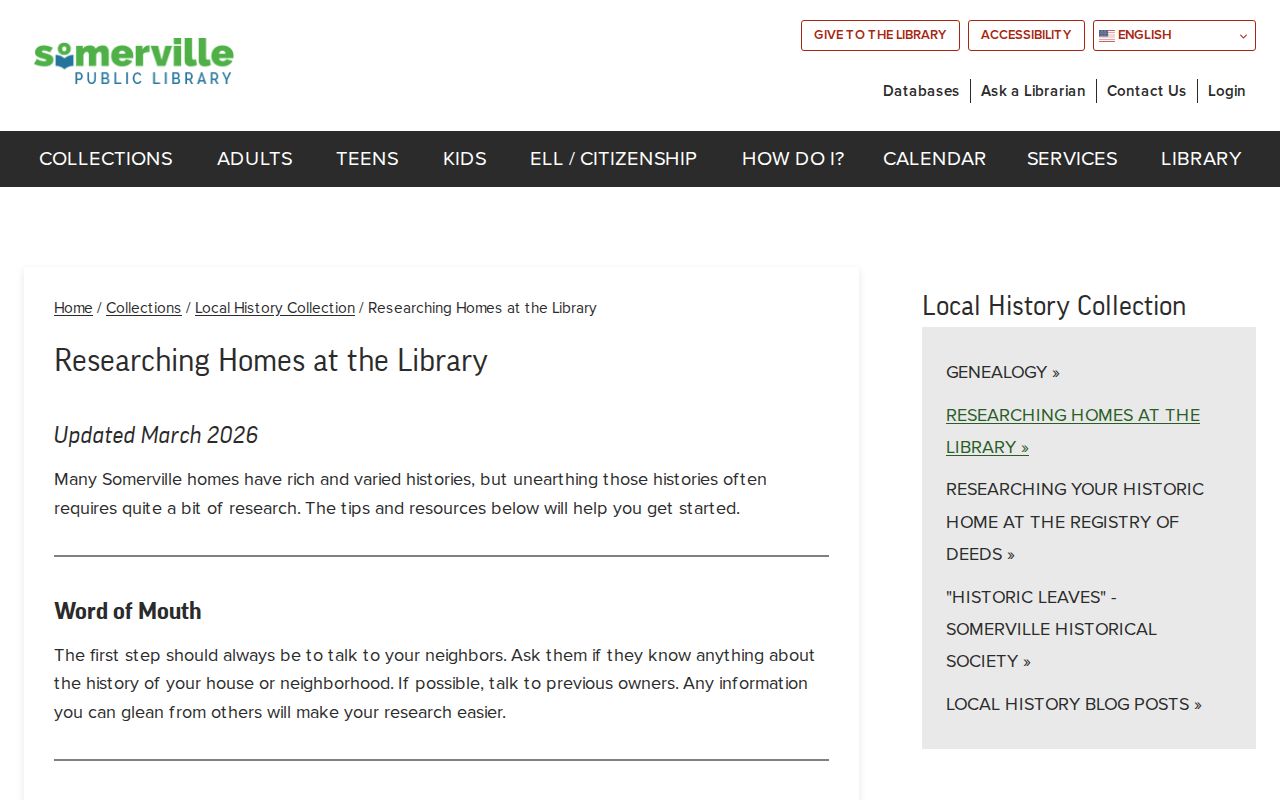
The library’s guide is a useful check on the sequence of sources, especially when a building was altered, split, or rebuilt. It keeps deeds, maps, permits, and directory evidence in their proper roles.
Use the guide’s map sequence to compare the present parcel with the Hales, Draper, Walling, Hopkins, Bromley, Stadley, and Sanborn sources named for Somerville. The 1900 Library of Congress Sanborn atlas contains 121 sheets, while later map material is available through library resources. A map dates a building form or street setting; it does not identify everyone who lived there.
Somerville Records Before Cityhood
Address research that reaches into the nineteenth century must account for Somerville’s changing civic setting. The library keeps Charlestown directories for 1834–1874 because Somerville was officially part of Charlestown until 1842. Massachusetts statewide vital registration began in 1841, and Somerville became a city in 1872. A name that seems absent from a modern Somerville search may therefore appear under Charlestown, a town-era record, a ward record, or a later city system.
Ward geography also changes. The 1889 directory records four wards, while modern Somerville uses seven wards and precincts after reprecincting following the 2020 Census. Compare old street names and abbreviations with the historic maps, the current parcel map, deed description, and ward maps. No official citywide street-renumbering list was located, so a date should never be guessed simply to make an old address fit.
Note: Keep the source year beside every address form, because an old ward, street abbreviation, or Charlestown reference may be the key to the next record.
Somerville Previous Residents and Privacy
Past residents can be researched for family history, an estate trail, or the history of a place. Use the sources to document what a dated record actually says. Obituaries, the library’s subject and obituary index, probate files, cemetery inscriptions, and the Somerville Journal can help close a historical trail, but each needs its own citation and date. The City Archives collects permanent city-government records, not private resident papers, and directs personal or family-history questions toward the Library Local History Room or Somerville Museum.
Public records still have limits. An owner record is not a list of every household member. Confidential voter registrations, protected addresses, sealed court material, sensitive vital-record categories, utility accounts, and delivery information are not ordinary address-search material. Massachusetts also offers the Address Confidentiality Program under M.G.L. c. 9A for qualifying participants. A historical inquiry should never be used to identify, follow, or pressure a living person.
Lawful use. Somerville previous-resident research is best kept to documented house history, family history, estate questions, and civic curiosity. Do not use a record trail to stalk, harass, or harm any person.