
Somerville City Directory Holdings
The Somerville Public Library Local History Room is the main local keeper for city directories. Its coverage has an important split: the 1851 through 1933 books are alphabetic by name, while the 1939 to present set is arranged by ward, precinct, and address. That change affects the first search. A name is the best entry point for an early book. A later volume can be followed through its address arrangement after the ward and precinct are known.
| Directory set | Years available | Somerville keeper | How to consult |
|---|---|---|---|
| Charlestown directory volumes | 1834–1874 | Library Local History Room | Printed or microfilm volumes |
| Somerville name volumes | 1851–1933 | Library Local History Room | Alphabetical name arrangement |
| Somerville address volumes | 1939–present | Library Local History Room | Ward, precinct, and address arrangement |
| Poll-tax directories | 1887–1938 | Library Local History Room | Microfilm, ward to precinct to street |
| Selected scanned directories | 1869–1919 | Library-linked collections | Browseable online scans, not every year |
| Somerville and Boston phone books | 1911–present, with gaps | Library Local History Room | Paper and microfilm |
The published run has a 1934 through 1938 gap between the named set and the post-1939 arrangement. Do not fill that gap by assumption. Ask the library for the relevant volume, microfilm, or a companion source. The Local History Room is at Central Library, 79 Highland Avenue, and its Ask a Librarian service accepts genealogy and local-history questions. The published desk extension is 2955. Routine replies generally take one or two business days, although genealogy inquiries can take longer.
The Local History Collection page shows the Somerville directory resources alongside poll-tax directories, newspapers, maps, census access, and yearbooks.
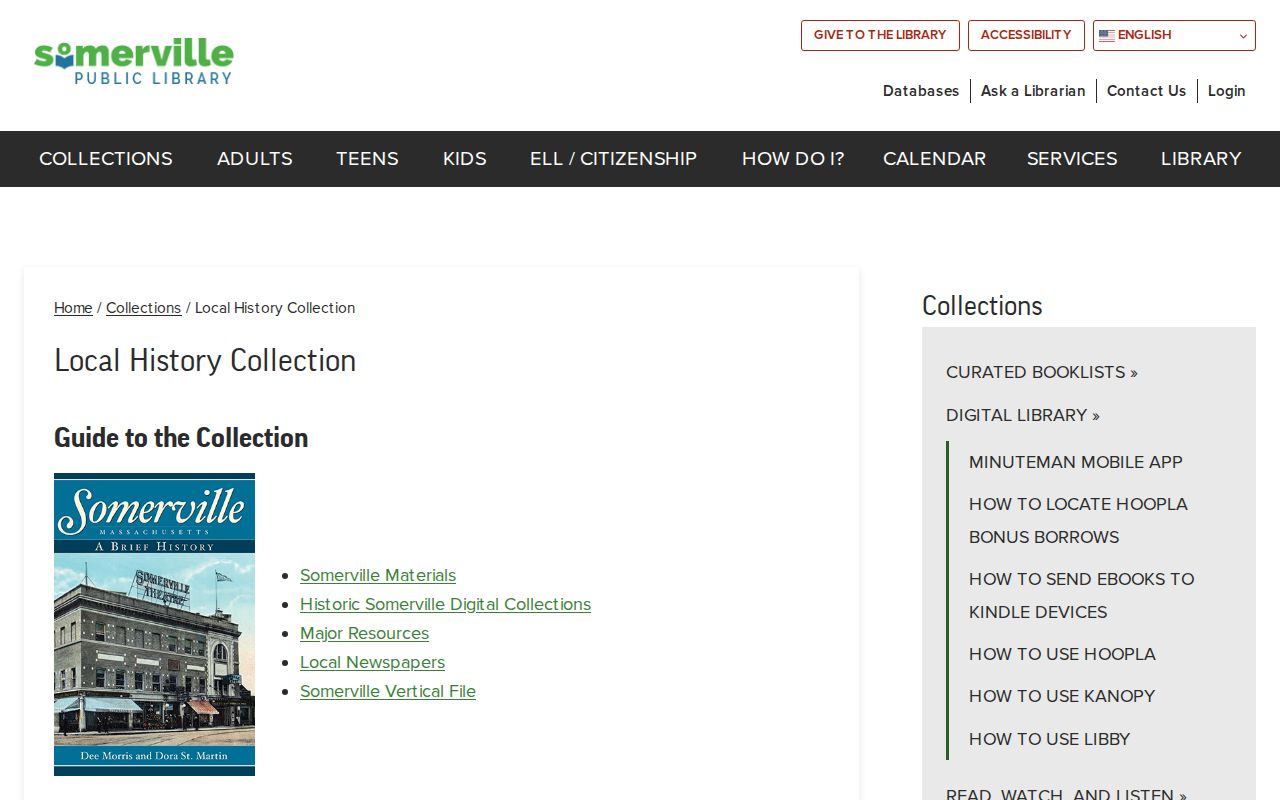
The library brings those formats together, which makes it easier to compare a directory entry with a newspaper notice or map from the same period.
Somerville Directories Before 1842
Somerville was officially part of Charlestown until 1842. That is why the Local History Room holds Charlestown directory volumes for 1834 through 1874. A person associated with an early Somerville street may be indexed under Charlestown rather than under a later city name. Check the year first, then preserve the place name as the volume gives it. It is a records-geography issue, not a spelling mistake.
- 1834–1841: search the Charlestown volumes for territory that later became Somerville.
- 1842: treat the separation from Charlestown as a boundary in the local trail.
- 1851 onward: use the first local Somerville directory run, then compare later annual books.
- 1939 onward: switch from name-first searching to ward, precinct, and address order.
Somerville became a city in 1872, bringing city clerk, ward, poll-tax, and annual-report records into the local picture. Those changes explain why the same family may leave a different kind of paper trail over time. A historical address should stay tied to its original year and custodian.
Somerville Directory Scans Online
Library-linked scans make selected volumes available through HathiTrust, Internet Archive, and HDL. The digitized list includes early books from 1869–70, 1871–72, 1873, 1875–76, 1877, 1879–80, and many annual volumes through 1919. It is a selected online group, not a complete web run. When a needed year is absent, the library’s physical shelf and microfilm remain the proper fallback.
Internet Archive’s 1889 Somerville city directory scan provides page images as well as OCR and downloadable formats.
The 1889 volume identifies W. A. Greenough of Boston as publisher and has 1,212 scanned pages, so a page image can be checked when OCR makes a surname hard to read.
The library also points researchers to a searchable Somerville newspaper archive covering 1870 through 1996 and to city annual reports. A directory can establish a year and address; a newspaper or annual report can add the event or civic context that the entry leaves out.
Decode a Somerville Directory Entry
An entry in the 1889 book is a compact historical record, not a current household list. It uses surname and given name, then may add an occupation, business address, home indication, boarding wording, or a family note. The same address can refer to a person at home, someone boarding there, or a business location. Read the abbreviations before treating the entry as a precise statement.
| Name form | Surname and given name or initials, sometimes with an honorific. |
|---|---|
| Occupation | A role such as teller, builder, electrician, clerk, or maker, sometimes with a named business. |
| Home wording | h. introduces a home street and number. |
| Boarding wording | bds., b., or rooms identifies boarding or rooms rather than title to a parcel. |
| Family clue | A widow notation or a reference to another household can connect people without proving every relationship. |
| Place shorthand | W.S., W.H., E.S., and N.S. mark West, Winter Hill, East, and North Somerville. |
- Criss-cross directory
- A separate address-order directory that lists households by street. No standalone Somerville series was located; later ward, precinct, and address volumes fill much of that role.
- Householder index
- An index organized around the person or household heading instead of a street sequence.
- Abbreviation key
- The volume’s guide to shortened terms. Photograph or note it before interpreting h., bds., neighborhood initials, or street shorthand.
Check an uncertain name against the scanned image. The local research notes that initials, married or widow names, and OCR noise can confuse a result. Address, spouse wording, occupation, ward, and chronology are stronger together than a surname alone.
Note: A directory compiler recorded an observed connection for that edition, so it should be paired with another dated source before drawing a firm conclusion.
Somerville Directories by Address
The local arrangement changed in a useful way. For 1851 through 1933, start with the name because the Somerville city directory run is alphabetic. For 1939 to the present, locate the ward and precinct, then use the address arrangement. This local shift is the closest documented substitute for an address-first reverse directory. It also means a search method that works in 1940 may fail in 1889.
The poll-tax directories add another address-based source from 1887 through 1938. They run ward to precinct to street address and exist on microfilm. Before 1920, they list only men, so absence does not show that a woman or family was absent from the address. The later directory format and poll-tax books should be compared with the year, not blended into one undated roster.
Modern address-keyed property and parcel work belongs with the Somerville street directory lookup. Historical books are best used to establish the person, spelling, household clue, and time period before moving into a current records search.
Trace Somerville Directory Households
Start with one volume and make a dated note of the spelling, initials, street number, neighborhood notation, occupation, spouse or widow wording, and h., bds., or rooms mark. Then compare adjacent years. A move, changed initial, new spouse wording, or a switch from home to boarding wording may be a lead, but it is not a conclusion by itself.
- Use the name section for 1851–1933 or the ward, precinct, and address section for 1939 onward.
- Copy each printed detail and the volume year exactly, including street abbreviation and neighborhood initials.
- Search adjacent years for a move, a changed name form, a widow entry, or a missing listing.
- Check the 1887–1938 poll-tax microfilm or phone books from 1911 forward when the date fits.
- Pair the directory decade with a federal census checkpoint, then test major changes against an obituary, deed, probate filing, or vital record.
The library provides federal census microfilm for 1790 through 1910 and online access described through 1940. Federal census releases follow the 72-year rule, so later decades cannot be filled from that archive. A disappearance from a directory can reflect a move, death, a different name form, a compiler’s omission, or an unavailable year.
Historic Leaves Directory Clues
Historic Leaves, the Somerville Historical Society serial held in the Local History Room, ran from 1903 through 1915. Its first volume includes a transcription of the 1851 Somerville directory in three alphabetic parts: A–Bo, Bo–He, and He–Z. It also carries neighborhood sketches, cemetery inscriptions, obituaries, military material, and family history. That combination can help when a terse city directory entry needs a place or family connection.
The library’s Historic Leaves holdings page describes the historical-society serial and its Local History Room access.
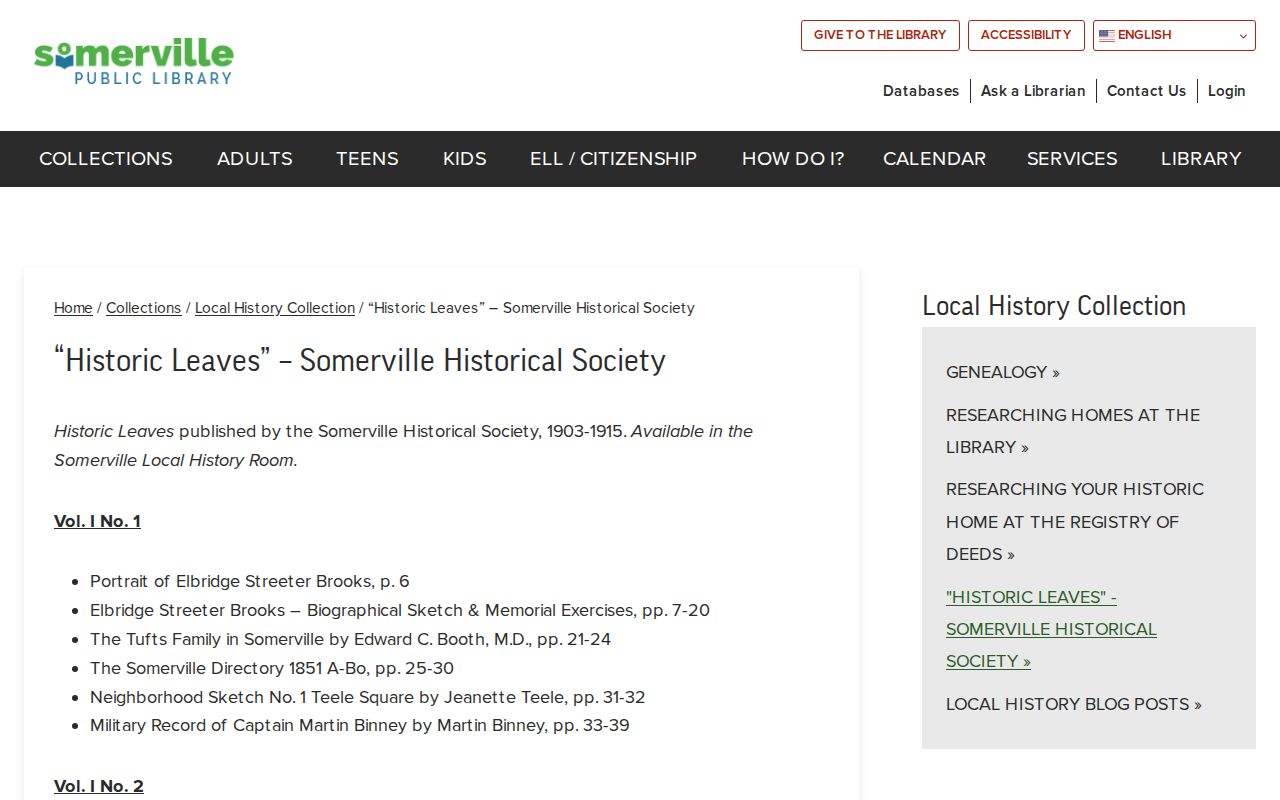
Its 1851 transcription and neighborhood material give the directory trail a local narrative layer without turning a historical society membership list into a current-resident source.
Somerville Directory Companion Records
When a name is hard to separate, add a source that answers a different question. The Local History Room has a subject and obituary index, newspaper microfilm, yearbooks, phone directories, maps, Sanborn material, and census routes. The Somerville High School Radiator archive spans 1898 through 2016, making it a useful former-classmate lead when the class year is known. It does not prove a present address.
The Somerville City Archives, a City Clerk division, preserves permanent city-government records in paper, images, microfilm, photographs, and born-digital forms. Its downloadable Preservica repository can add a city document or exhibit to a directory trail, while the Archives directs private-family and organization material to the Library Local History Room or Somerville Museum. Cite the folder heading, item date, or issue date instead of relying on an undated description.
Maps can explain a street name, ward, or development context. The city’s historic-preservation guide identifies Somerville maps and atlases from the nineteenth and twentieth centuries, while the Library of Congress 1900 Somerville Sanborn atlas has 121 sheets in the public domain. For a modern name check after the historical trail is established, the Somerville resident lookup page keeps the focus on dated official records and their limits.
Note: Keep the volume year, page, spelling, and image location with every citation, especially when a result came from OCR rather than a manually read page.